
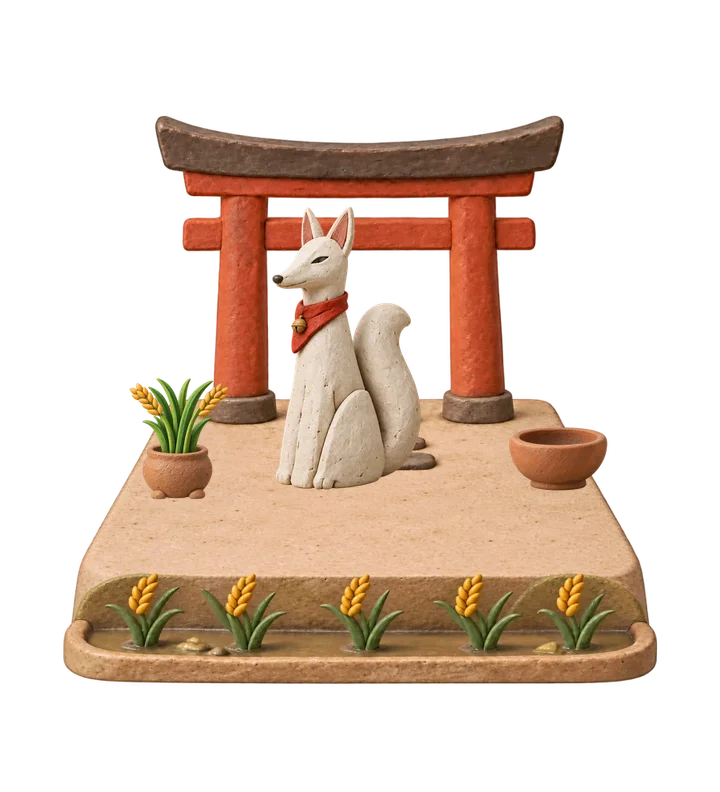
In Little Shrine the fox stands beside rice and a vermilion gate. Read the scene as an approach: the messenger introduces the presence honored beyond the threshold. The rice draws attention to nourishment and harvest, associations that a portrait of a fox alone would leave out.
Why a fox greets visitors at an Inari shrine
稲荷大神 · Inari Ōkami, the deity served by the fox messenger
Fushimi Inari Taisha dates the enshrinement of Inari on its Kyoto mountain to 711, according to shrine tradition. The shrine appears in the Engishiki register in 927. These are different kinds of historical evidence: one is the foundation date preserved by the institution, the other a record of the shrine’s standing within an official system.
Inari’s connections with rice and sustenance help explain the grain in shrine imagery. The foxes along the approach are understood as messengers. If a guide labels a fox simply “Inari,” it removes an important relationship. The animal can be the first figure a visitor encounters precisely because a messenger stands between an approaching person and the deity honored within.
Dedications of torii give the mountain paths another layer of history. Each gate can mark a prayer or thanks offered by a particular donor. Seen together, the gates change the landscape through which later visitors walk. A fox, a rice bed and a gate in one miniature bring three strands together: the messenger, the source of nourishment and an approach made by generations of worshippers.