
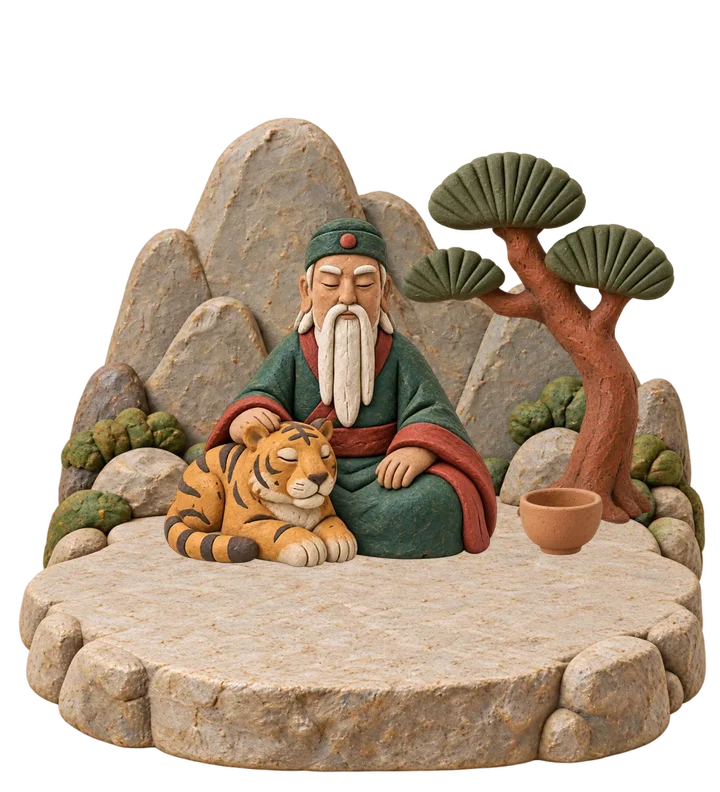
The National Museum of Korea provides a collection example. Look at how close the tiger sits to the human figure, then trace the pine behind them. Little Shrine adopts an elder as one interpretation of Sansin. Local traditions allow other forms of the mountain spirit.
How mountain devotion found a place in Korean Buddhist temples
산신 · Sansin, mountain spirit
A mountain in Korea could be the protector of a particular community as well as the site of a Buddhist monastery. Devotion to its spirit could retain a distinct place within the temple grounds. A Sansingak, or mountain-spirit shrine hall, allowed worshippers to address the mountain spirit within that larger religious setting.
Joseon-period paintings preserve this relationship. In an example at the Met, an elder appears with a tiger. Its size and execution suggest it once belonged to a shrine in a Buddhist temple complex. The National Museum of Korea also identifies a painting in which the tiger may be understood as an avatar. The animal’s role therefore deserves closer attention than a simple label such as pet or companion.
The familiar male elder is one representation within a wider body of local belief. Names, forms and rites can vary with the mountain and the community. A painting removed from its hall gives unusually good access to the artist’s brushwork. A record of a particular mountain rite restores something a museum wall cannot show: who gathered there and when.