
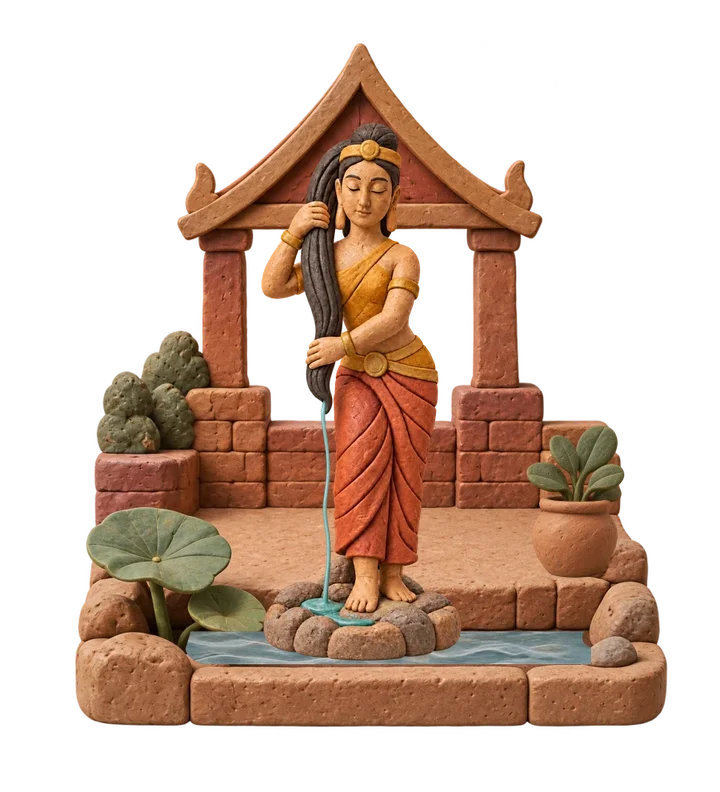
Follow the line from her hands to the ground. In Little Shrine a narrow stream joins the front channel, connecting her gesture to the earth below. Set this image beside the earth-touching Buddha: one image shows the appeal to the earth and the other gives the witness a form.
How the earth became a witness in Thai Buddhist art
พระแม่ธรณี · Phra Mae Thorani, Mother Earth
In the story of awakening, Māra challenges the Buddha’s right to the place where he sits. The future Buddha reaches down to call the earth as witness. Thai images develop the witness into a figure in her own right: a woman who gathers her long hair and wrings water from it. The seated Buddha’s gesture and Thorani’s action can be read as two moments in the same encounter.
Water here has a history within the story. It recalls acts of generosity across the Buddha’s previous lives and the water poured in dedication of merit. In one telling, the water released from the goddess’s hair overwhelms Māra’s army. Knowing that sequence explains why a stream can be central to an image of an earth goddess.
A bronze figure cataloged by the Asian Art Museum isolates the hair-wringing gesture from the larger narrative. The action remains legible even when neither the tree nor the opposing army is present. A northern Thai agricultural account gives a different setting for addressing the earth before cultivation. Those two settings preserve different relationships to Thorani, one narrative and one rooted in work on the land.
Look closer
How does Thorani appear in a northern Thai cultivation rite?