
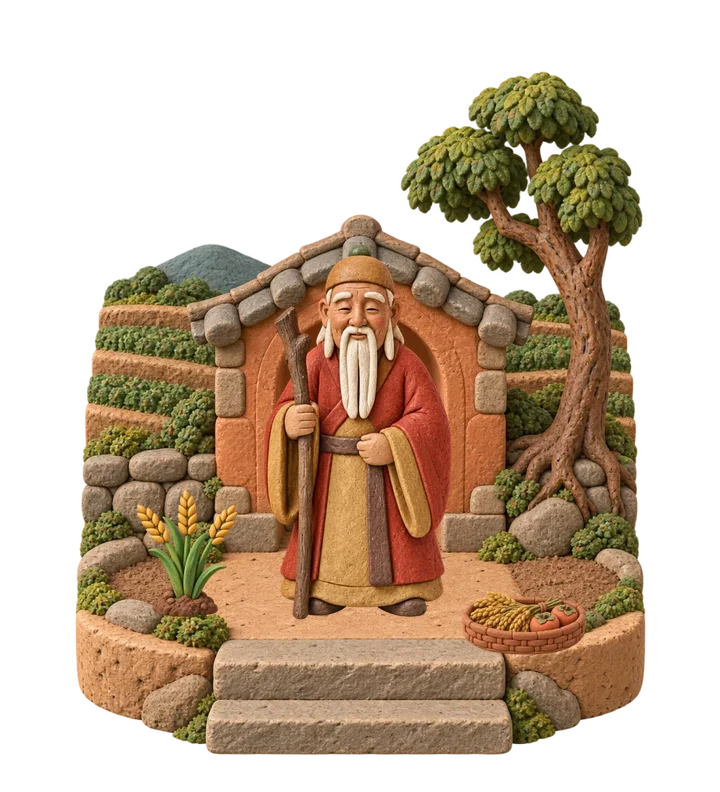
The Taoyuan Tudigong Culture Museum connects this belief with agricultural settlement. Little Shrine uses terraced earth, rooted rice and a harvest basket to make that connection visible. Imagine taking away the fields: the elder’s staff alone would tell much less of the story.
A local history written into the fields
土地公 · Tǔdìgōng, often titled Fúdé Zhèngshén
A useful way to approach Tudigong’s history is to ask how a settlement grew. In Taiwan, a community establishing fields and homes could set aside a place for the guardian of that land. The extent of the guardian’s responsibility was local. Several small shrines close together could therefore preserve the outlines of different neighborhoods or cultivated areas.
The Tudigong Culture Museum in Taoyuan places this worship in the history of migration, settlement and agricultural work. People from different places brought particular patron deities with them, while devotion to the land god could be shared across those differences. A shrine at a field edge tied the work of obtaining a harvest to the obligation of giving thanks.
In 2016 Taoyuan’s city government described nearly three hundred Tudigong temples in Taoyuan District alone. That is a local historical count, not a census of present-day Taiwan. It helps explain why a modest building on an urban street can matter: the surrounding land may have changed use many times while the neighborhood still knows where its shrine stands.
Taoyuan City Government · Tudigong Cultural Hall and local settlement
Look closer
- Taoyuan Tudigong Culture Museum: belief and agricultural settlement
- Taoyuan Tudigong Culture Museum: shrines and statues