
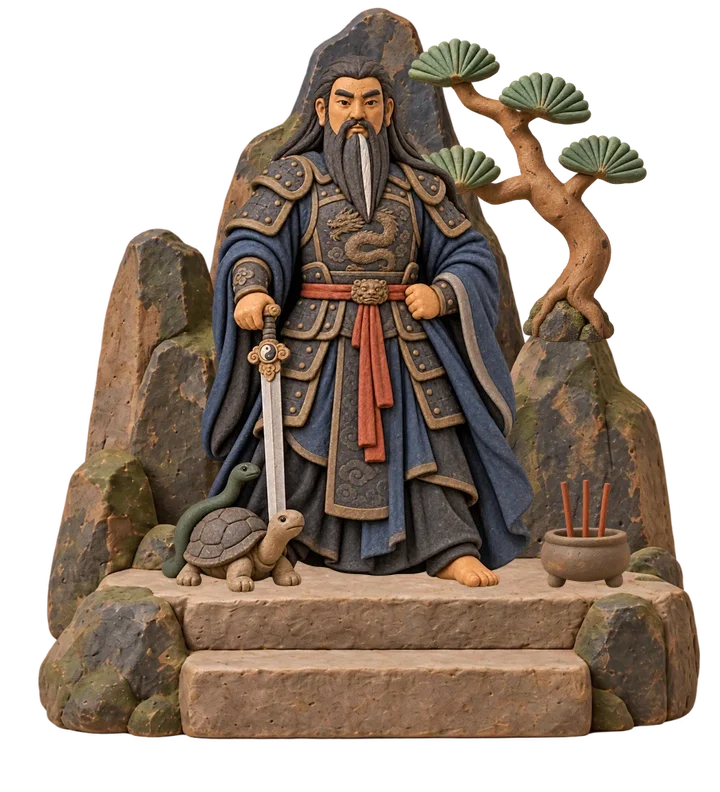
Look down toward the base before looking at the face. The animals concentrate attention at the figure’s feet while loose hair and armor give the upper body its outline. Compare the Ming-period figure at the Met with the way the miniature groups the three silhouettes.
How a northern emblem became an imperial protector
真武 · Zhēnwǔ, the Perfected Warrior
The intertwined tortoise and snake belonged to an ancient Chinese system of directional emblems. Together they marked the north. Their continued appearance beside Zhenwu preserves a trace of the figure’s history: the animals were recognizable before artists gave the power associated with them a human body.
In the eleventh century, Song emperors sponsored temples for the personified deity. Under the Ming, Zhenwu’s protection acquired particular importance for the ruling family and the empire. The military bearing and armor of a Ming image make sense in that political setting, as well as in the Daoist religious tradition in which the deity was worshipped.
Patronage at court did not confine devotion to imperial temples. The Met identifies its fifteenth-century figure as one made for a home altar. Its small size is evidence of a different audience for the same deity. Looking from the scale of the object to the animals at its feet connects household practice with a much older account of the cosmos.